


Recap: The Power of Collective Impact
If you joined yesterday thank you! So many of you are already navigating the hard parts of coordination across programs and partners, and I hope you left with something useful.
Four things worth holding onto:
-
Alignment over uniformity - Collective impact isn't about every organization doing things the same way — it's about creating enough shared structure that your work can connect where it needs to.
-
Fragmented data is a coordination barrier - When partners can't see the same picture, gaps go unnoticed and handoffs break down.
-
Shared measurement is a learning tool - When it's working well, it helps your whole partnership adapt together — not just report together.
-
Apricot capabilities worth thinking about - Data Standards can help create a common language, Networks can support coordination across organization, and Impact Hub can help create shared visibility
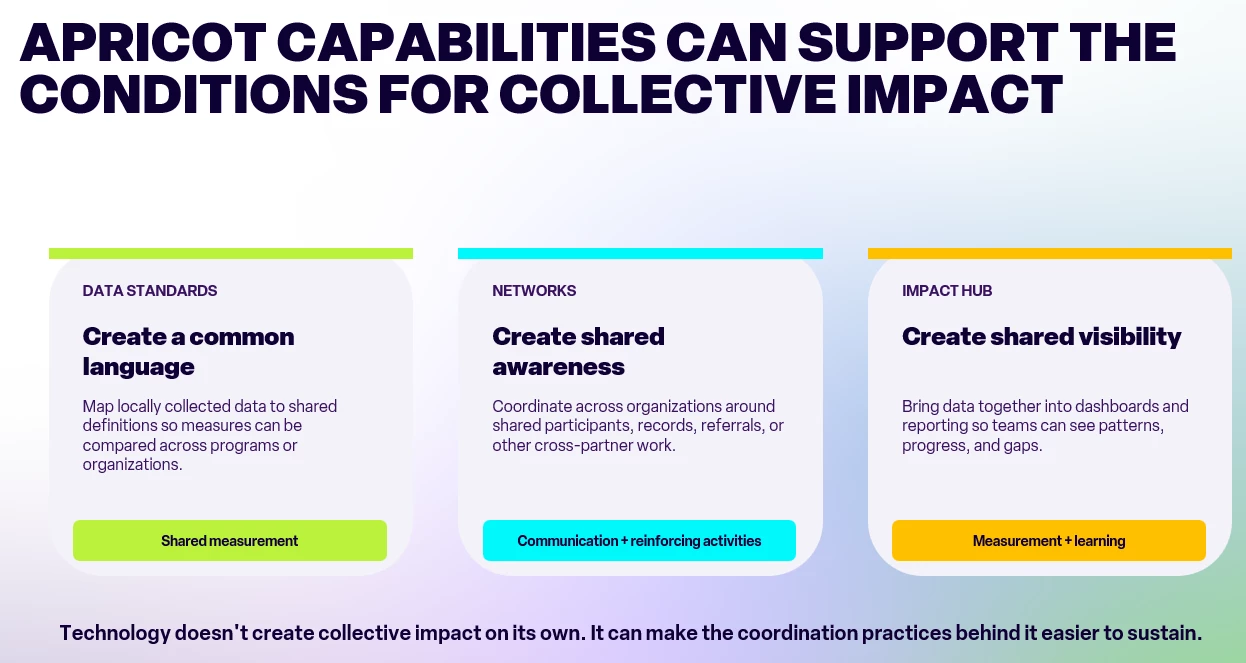
As taken from Kelsey’s presentation:
“Apricot doesn’t create collective impact. The relationships, agreements, governance, and shared goals have to come from the people doing the work. But technology can make those practices much easier to sustain.
The goal isn’t more technology. The goal is better coordination—and ultimately, better outcomes for the people and communities you serve”
If this conversation has you thinking about what Collective Impact could look like for your organization, reach out to your Account Manager — there's no one-size-fits-all answer, but there's almost always a place to start.
▶️ Rewatch the coaching and demo: The Power of Collective Impact: Coordination Across Partners, Systems, and Programs
Bonterra Resources: