


How does Grant Analysis work?
Grant analysis runs when you open a tracked grant in the Bonterra Nonprofit Hub. It assesses the opportunity against your organization's profile and gives you structured guidance across three dimensions — eligibility, effort to apply, and award profile — plus a set of considerations. Together, these give your team the context to make a confident decision about whether to pursue the grant before investing time in an application.
Every dimension includes a label, a rationale explaining how the result was reached, and source attribution so you know what data informed the analysis.
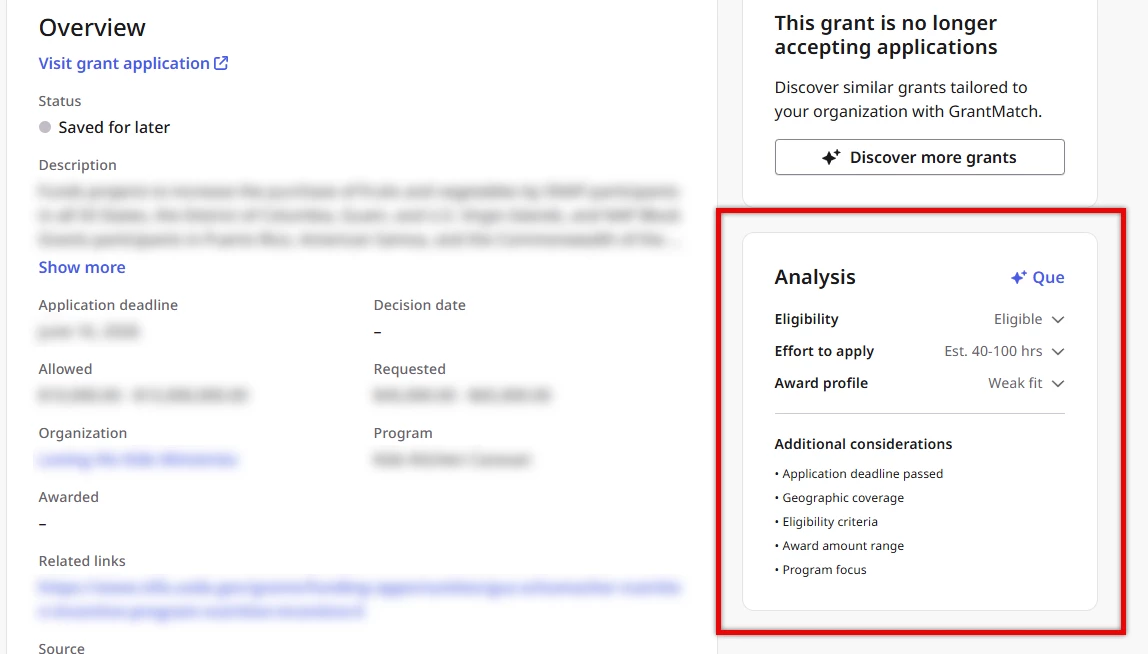
Eligibility
The eligibility assessment answers the question: does my organization meet this funder's basic requirements? The analysis checks your organization type (nonprofit, government entity, educational institution), service geography, budget size, and program focus against what the grant description states.
The result is one of three labels:
- Eligible — Your organization meets all the funder's stated requirements based on your profile and the grant description.
- Not eligible — The evaluation found an explicit disqualifying factor — for example, your annual budget exceeds the grant's maximum threshold, or your organization type doesn't match. This is a strong signal to deprioritize the grant unless you believe the evaluation misinterpreted the requirements or your profile is outdated.
- Unsure — The evaluation couldn't determine eligibility with confidence. This usually happens when the grant description is vague about requirements, or when your organization profile is missing key information (like service geography). The rationale will identify which factor couldn't be evaluated.
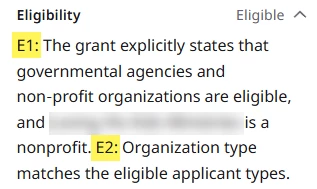
The image above is a sample of an Eligible assessment.
The eligibility assessment uses your organization profile and the grant description. If your profile is incomplete — for instance, if you haven't recorded a service area — some checks can't run and the result may show as Unsure. Keeping your profile current improves accuracy.
Effort to apply
The effort-to-apply assessment answers the question: how much work is this application? The analysis estimates a realistic hours range based on narrative scope, number of deliverables, budget complexity, pre-application steps, and required support materials.
The result shows a range — for example, 8 to 12 hours, or 40 to 100 hours. The lower end assumes your organization has reusable templates, existing program data, and a quick approval process. The higher end accounts for gathering new information, revising for the funder's specific requirements, and handling multiple review cycles.
Alongside the hours range, you'll see a concrete deliverables list — the specific documents and materials you'll need to produce, such as a project narrative, line-item budget with justification, letters of support, logic model, or evaluation plan. This list comes directly from the grant requirements and serves as an early application checklist.
Award Profile
The award profile answers the question: how well does my organization align with what this funder funds? The analysis considers your mission, program focus, and (when funder data is available) whether the funder has a history of funding organizations like yours. This is a fit assessment, not a prediction of whether you'll win.
The result is one of four labels:
- Strong fit — Your organization's mission and programs closely match the grant's priorities and (if available) the funder's giving history shows they fund organizations like yours.
- Moderate fit — There is meaningful alignment, but not a perfect match. For example, you operate in the funder's geographic focus area but your program serves a slightly different population than their historical grantees.
- Weak fit — The alignment is limited. The funder's priorities don't closely match your programs, or their giving history shows they rarely fund organizations at your scale or geography.
- Unclear — The evaluation couldn't assess fit with confidence, usually because funder giving history isn't yet available. Unclear is not a signal that the grant is a poor fit — it reflects limited data, not a negative finding.
When funder data is available, the award profile can evaluate geographic alignment, typical grantee size, and historical recipient patterns. When it's not available — which is common for government and corporate funders — the assessment uses only your organization profile and the grant description, which may result in Unclear.
Considerations
Beyond the three dimensions, the analysis surfaces considerations — factual observations about the grant that don't fit neatly into a single dimension but matter for your go/no-go decision. Common consideration types include:
- Cost sharing or matching requirements — The funder expects your organization to contribute a percentage of the project cost. Flag this with your finance team early.
- Post-award reporting expectations — The grant requires specific reporting on outcomes, spending, or activities after an award. Understanding reporting frequency before applying helps you assess compliance obligations.
- Payment structure — Whether the funder reimburses expenses after the fact or provides advance funding. This matters for your organization's cash flow.
- Funder patterns — Observations about how the funder typically gives — for example, whether they prefer multi-year projects, rarely fund new organizations, or primarily fund specific geographies.
- Application logistics — Pre-registration requirements, multi-stage submission processes, or specific portals (like SAM.gov for federal grants or a letter of intent deadline).
Each consideration includes a source attribution — 'Stated in guidelines' or 'Funder history' — so you know where the observation came from.
Source attribution and updates
Every analysis includes a list of which sources informed the results — your organization profile, the grant requirements, funder giving history, or other inputs. This transparency lets you see exactly what the evaluation is based on and spot areas where more complete information might improve future results.
The analysis updates automatically when your organization profile changes or when the grant's details are refreshed. Each evaluation includes a timestamp so you can tell whether it reflects current information.
What else do you need help with?
- How do I explore grant opportunities with Bonterra’s GrantMatch?
- How do I interpret my Grant Evaluation?
- How do I make a Go/No-Go Grant decision?
- What is grant proposal drafting in the Nonprofit Hub?
- How do I generate and refine a Grant proposal?
Not what you’re looking for? Navigate to Understanding Grant Discovery and Readiness in the Nonprofit Hub