


How do I make a Go/No-Go Grant decision?
Once you have reviewed a grant evaluation, use the three dimensions—eligibility, effort to apply, and award profile—together with the considerations section to decide whether to pursue the opportunity. The following steps walk you through each scenario and what to do next.
Step 1: Check whether all three Go conditions are met
Start by reviewing all three evaluation dimensions together. If all of the following are true, you have a clear signal to pursue the grant:
- Eligibility check passed
- Effort hours fit your team’s realistic capacity for this application cycle
- Award profile is at least Moderate Fit
When all three conditions are aligned, the grant is worth your time and attention. Move to Step 4 below to learn about reviewing the considerations before committing, then proposal generation.
Step 2: Evaluate whether a cautious Go is appropriate
If Eligible and effort is within reach, but the award profile is a Weak Fit or Unclear, this is not an automatic pass—it is a signal to proceed carefully.
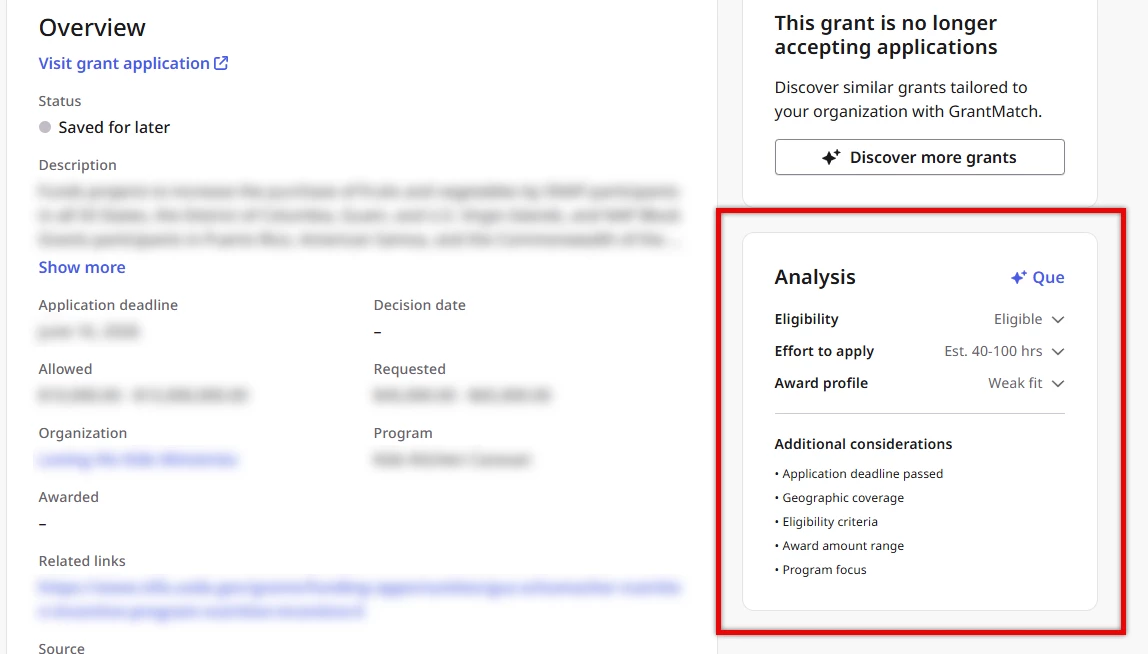
A cautious go may be appropriate if any of the following are true:
- The award amount is unusually large relative to the effort required
- Building or strengthening the relationship with this funder is strategically important for your organization
- The award profile is Unclear due to limited funder data rather than a confirmed misalignment
If you decide to move forward under these conditions, plan for a higher-effort application. Your proposal narrative will need to work harder to demonstrate alignment with the funder’s stated priorities. Do additional independent research before committing—look at the funder’s recent grantee list, stated focus areas, and award history to assess whether organizations like yours are in their funding mix. Budget extra time to frame your application explicitly around what the funder cares about.
Step 3: Identify any No-Go conditions
Pass on the grant if any of the following conditions apply. One is enough to stop.
Eligibility is ‘Not eligible’
A ‘Not Eligible’ result is a clear signal to pass unless you have a specific reason to believe the evaluation misread the requirements or your organization profile contains outdated information. If your profile is current and the evaluation is accurate, the effort of applying is not justified.
Before passing entirely, confirm: Is there a field in your organization profile—service area, population served, budget—that may not reflect your current state? If so, update your profile and re-run the evaluation. If the Not Eligible result holds after updating, pass.
Effort hours are far beyond your team’s realistic capacity
The hours estimates in a grant evaluation are conservative. If the range significantly exceeds what your team can realistically dedicate to a single application in this cycle, passing is often the right call. An underfunded application—one that does not get the attention it needs to be competitive—is worse than not applying at all, and committing to an application your team cannot fully execute will deprioritize other work.
As a practical test: if the evaluation estimates 200–400 hours and your team can allocate 40 hours this cycle, this grant is not the right use of your capacity right now.
Multiple considerations signal serious friction
Even when eligibility and fit look strong, a combination of unfavorable conditions in the considerations section can change the calculus. Pass—or pause for a deeper internal conversation—if any of the following apply:
- Cost sharing requirements your organization cannot realistically absorb
- Post-award reporting obligations that would strain your program staff beyond sustainable levels
- Payment terms or reimbursement structures that do not match your organization’s cash flow
- Pre-application registration requirements with deadlines your team cannot meet
Step 4: Review considerations before committing
Do not skip the considerations section, even when the three main dimensions look favorable. Cost-sharing requirements, reporting frequency, payment structure, and application logistics can each change your decision independently of eligibility and fit.
Before committing to a go decision, flag any relevant considerations with your finance and program teams. Confirm that your organization can absorb any cost sharing obligations, meet post-award reporting timelines, and manage cash flow under the grant’s payment terms. It is far easier to pass on a grant before you have started writing than after your team is twenty hours into the application.
Step 5: Move to proposal generation if it’s a Go
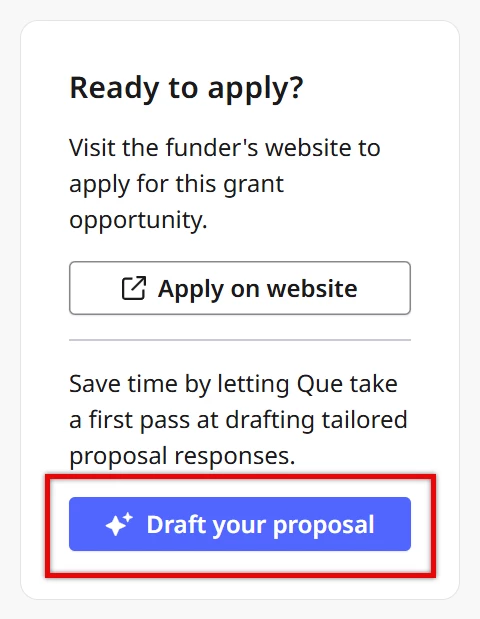
If you have decided to go, the next step is generating a proposal draft in the Bonterra Nonprofit Hub. Grant analysis and proposal generation share the same underlying data. When you generate a proposal for a grant you have already evaluated, the draft uses your eligibility signals, effort estimate, and award profile findings to shape the content—so the work you did in the evaluation carries forward directly.
What else do you need help with?
- How do I explore grant opportunities with Bonterra’s GrantMatch?
- How does Grant Analysis work?
- How do I interpret my Grant Evaluation?
- What is grant proposal drafting in the Nonprofit Hub?
- How do I generate and refine a Grant proposal?
Not what you’re looking for? Navigate to Understanding Grant Discovery and Readiness in the Nonprofit Hub